NFL Hall of Famer Dwight Freeney calls out league for putting games on too many streaming services
Pro Football Hall of Famer Dwight Freeney has said the NFL’s expanding reliance on streaming platforms risks shutting out fans who cannot afford multiple subscriptions, calling for a distribution model that keeps games accessible regardless of a viewer’s economic situation. “I think it should be accessible to all fans, no matter what your economic bracket is,” Freeney said. The 2024 Hall of Fame inductee, who recorded 125.5 sacks across a 16-season career, acknowledged that the financial logic behind the league’s media deals benefits players through higher revenues, but said he remains unconvinced the same arrangement serves ordinary supporters.
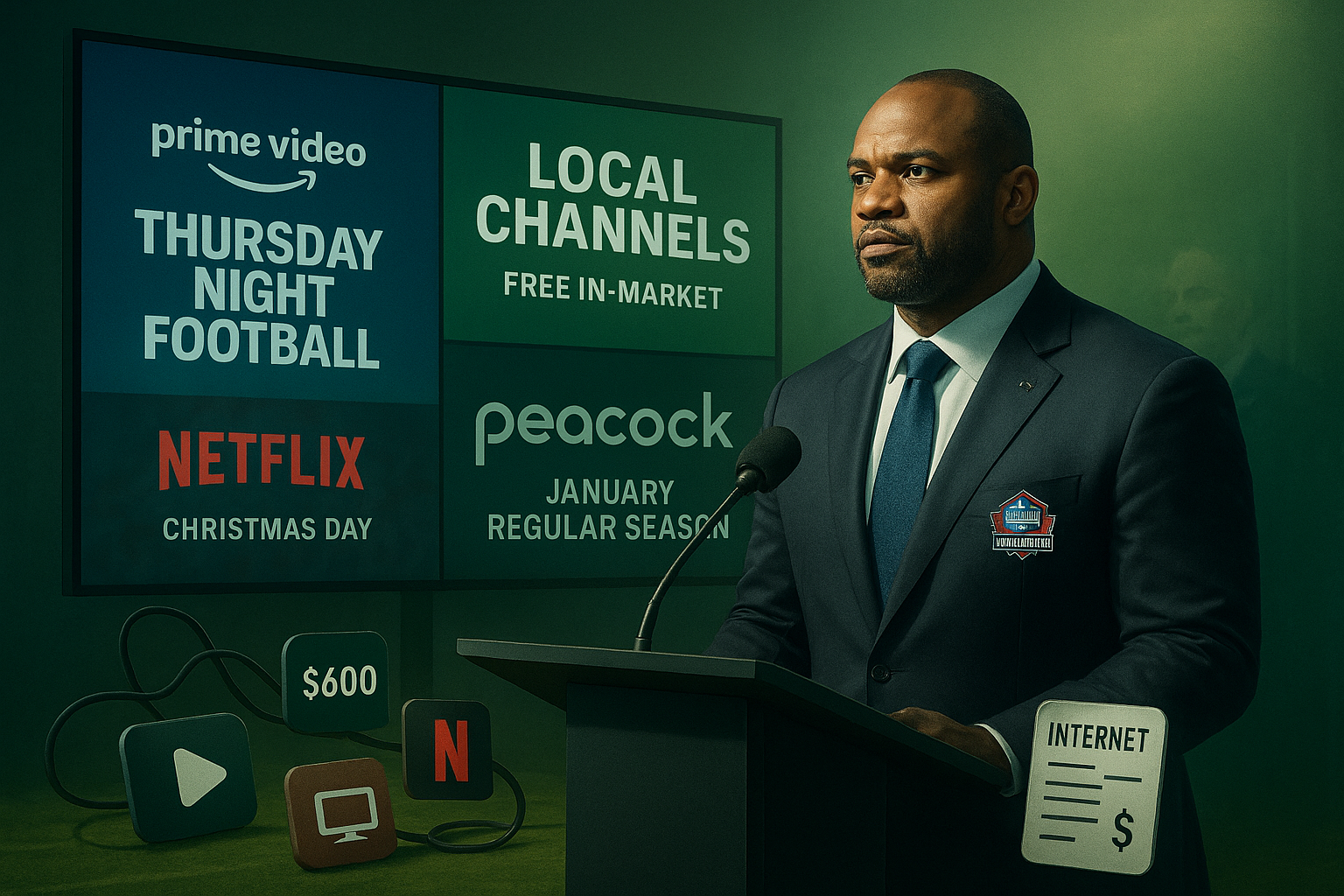
The NFL’s 2026 schedule distributes games across traditional broadcast networks, cable, and several streaming services. According to the league, Prime Video carries Thursday Night Football, Netflix streams games on specific dates including Christmas Day, and Peacock holds exclusive rights to a January regular-season contest. The NFL has maintained that all regular-season and postseason games remain available free over the air in local markets, a claim it has used to counter accessibility criticism. Freeney accepted that premise in part, saying fans who can access local channels should not find those broadcasts blocked by streaming exclusivity arrangements.
Congressional scrutiny of the NFL’s media model has grown alongside the streaming expansion. A June interim staff report from the House Judiciary Committee concluded that fans increasingly need a combination of over-the-air, cable, and streaming services to follow a single team, and estimated that some supporters pay more than $600 per season to do so. Senator Mike Lee separately asked the Department of Justice and Federal Trade Commission to examine whether the NFL’s distribution practices remain consistent with the limited antitrust protection afforded by the Sports Broadcasting Act, citing estimates that combined cable, streaming, and internet costs approached $1,000 for some fans last season.
Freeney said he personally subscribes to every available service and acknowledged that his own streaming costs are among the higher variety, but stressed that his situation is not representative. “Not everyone has that ability,” he said, adding that even with full access he sometimes struggles to locate specific games. He stopped short of proposing a specific structural fix, suggesting instead that a hybrid model combining streaming with preserved local network carriage could address the core tension – though he said he did not know how such an arrangement would be achieved.